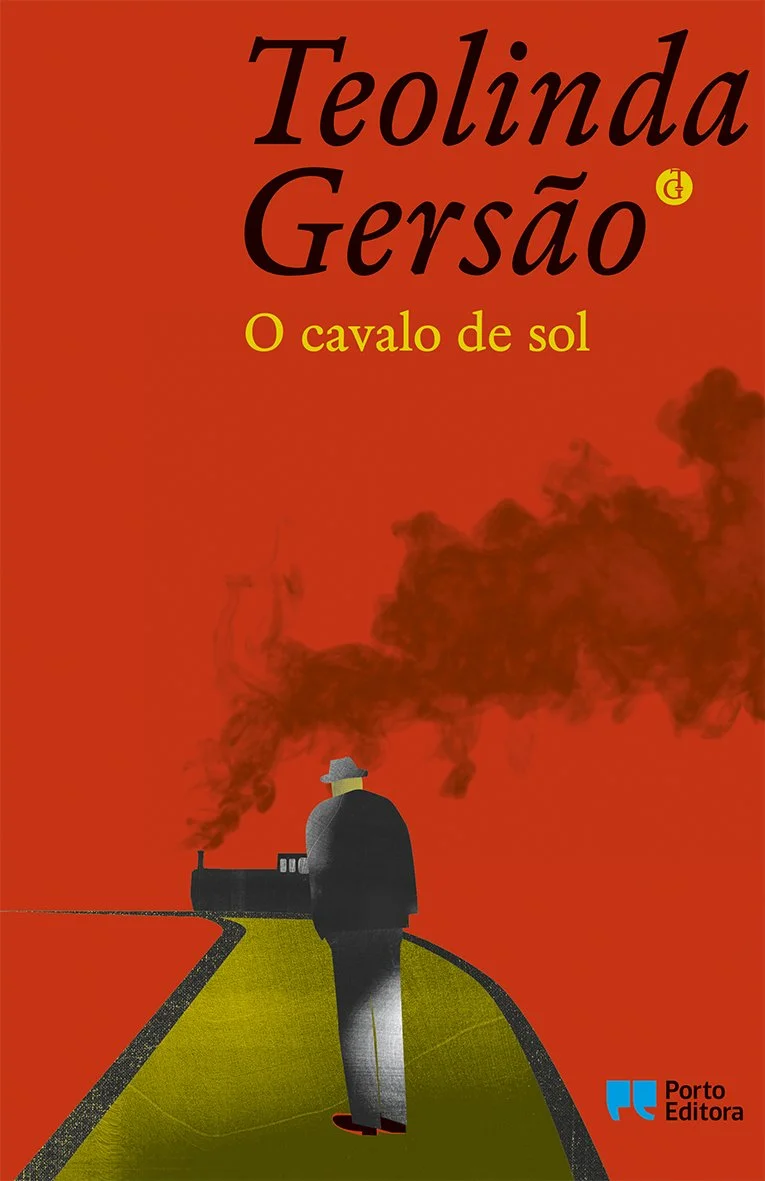
The Sun Horse / O cavalo de sol
A novel set in the 1920s, when heterosexuality was constrained by every kind of convention and homosexuality was both a social taboo and a crime under the law.
Written in visceral, razor-sharp and intensely sensual prose, it follows a body moving, in an increasingly accelerated rhythm, toward the discovery of itself and of the world.
-
Hotter than summer, only a story of forbidden love(s). Winner of the Portuguese P.E.N. Club’s Narrative Prize in 1989, O Cavalo de Sol portrays a narrow-minded rural Portugal of the 1930s, where rigid gender conventions were silent hells for women—and for the husbands who did not love them. Such is the case with Jerónimo, a repressed homosexual, and his cousin Vitória, forced to marry him, in a delicate, melancholy story that stands among the very best Teolinda Gersão has ever published.
ANTÓNIO MOURA DOS SANTOS, OBSERVADOR
“An extraordinary novel. … One of those books we keep close at hand, returning to it when memory asks and the heart commands. To revisit a sequence, pick up a detail, return to a word that stands out, luminous.”
MARIA LÚCIA LEPECKI, DIÁRIO DE NOTÍCIAS
One of the best novels of the current literary season.
PEDRO ALVIM, DIÁRIO DE LISBOA
We believe we are in the presence of this year’s most important and brilliant Portuguese work of narrative fiction: a dazzling display of virtuosity in novelistic creation, an exceptionally happy fusion of immense verbal artistry with masterful fictional discourse structures.
JOSÉ EMÍLIO NELSON, JORNAL DE NOTÍCIAS
In Teolinda Gersão’s texts, women continually seek words that offer them a free space […] and allow the expansion of their sphere. […] As a feminist text, O Cavalo de Sol problematizes traditional patriarchal discourse.
JOSÉ N. ORNELAS, Univ. Mass, COLÓQUIO LETRAS
O Cavalo de Sol is an exercise in precision in which nothing is left to chance. That precision is emblematically expressed in the horse’s movements: walk, trot, gallop, and jump—indeed, the titles of the novel’s four parts. The book is built with the rigor with which a rider prepares a jump. And what is at stake is precisely Vitória’s journey—an accomplished horsewoman—who forms with the horse a perfect, singular unity, up to the leap into the freedom of an autonomous life, up to victory over Jerónimo, over all the forces of the House that sought to destroy her.
ANA TERESA DIOGO, COLÓQUIO/LETRAS
From high on her horse, Vitória dreams of her cousin Jerónimo, whom she is to marry in a few months. Vitória is fascinating, unpredictable, and as she rides into the wind, pushing further and further against those around her, Jerónimo takes refuge in hunting, the arena where he can dominate his prey. The feast day approaches. Vitória clears the final obstacle and abandons Jerónimo. The celebration flees before the drama.
A strange novel, built to the rhythm of the horse’s gaits and the hammering of the heartbeat. While evoking the nostalgic atmosphere of a Portuguese family, the author skilfully stages the difficulties of human relationships in love, in a world “where nothing coincides with anything, where things are never equal to the idea we had of them.” Very quickly, the reader is carried away by the cadence of this brilliantly written story, in which the unreality of dreams, the violence of passion, and the unbridled struggle for the truth of things are woven together with great virtuosity.
NOTES BIBLIOGRAPHIQUES
The author wields lyricism at a gallop.
L’HUMANITÉ
Michel Leiris likened literature to bullfighting. Teolinda Gersão binds it to horsemanship in this unusual novelistic cavalcade. To the rhythm of equestrian time – walk, trot, gallop and jump – unfolds a struggle for passion and power, magnificently sustained by a prose that wonderfully evokes the sensual inertia of Portugal in the 1920s.
CONTEMPORAINE
-
Le Cheval de Soleil, transl. by Geneviève Leibrich, Paris, Flammarion, 1992
-
Prémio P.E.N. Clube Português de Narrativa, 1989
-
A casa de cabeça de cavalo
Um romance situado na 3.ª década do século XX, quando a heterossexualidade era reprimida por toda a espécie de convenções, e a homossexualidade tabu social e crime perante a lei.
Uma escrita visceral, acutilante e sensualíssima, em que o corpo avança, num ritmo progressivamente acelerado, para a descoberta de si próprio e do mundo.