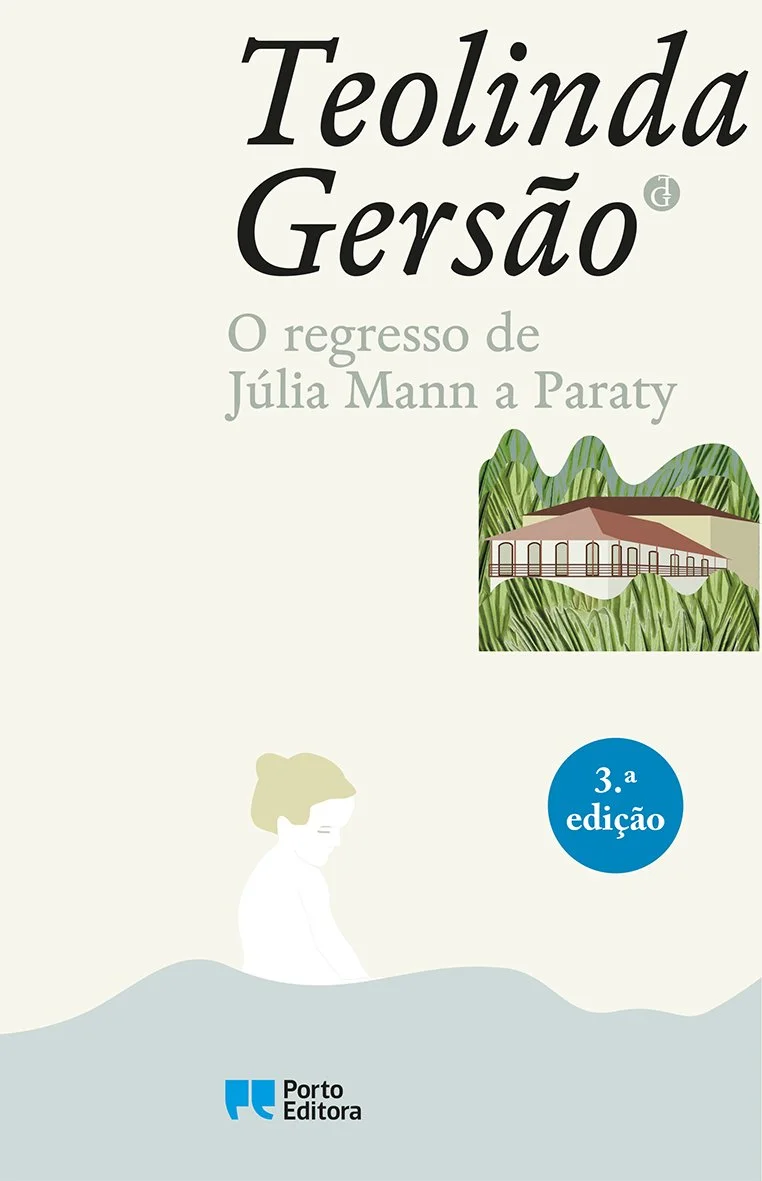
Júlia Mann's Return to Paraty/ O Regresso de Júlia Mann a Paraty
The Return of Júlia Mann to Paraty is composed of three chapters that intersect in surprising ways. Drawing on a profound knowledge of the lives and works of historical figures, and remaining faithful to the truth of the facts, the author reveals their inner worlds—vividly and convincingly fictionalised—in a fascinating narrative that holds the reader from the first page to the last.
-
Teolinda Gersão, one of the most important writers in all Portuguese literature, creates, in the three parts of her Julia Mann’s Return to Paraty (2021), a fictionalized version of the lives of three historical figures: Sigmund Freud, Thomas Mann, and Júlia Mann. Freud’s phrase is well known: the ego is a frontier-creature. … Freud and Thomas Mann identified their doubles and attempted to eliminate them, absorbing the other entirely. Teolinda, for her part, shows us how an entire life can be taken up with seeing the other as self, and vice-versa. We can see the chapters …as psychoanalytical exercises. …Gersão’s approach is convincing as she can accurately represent the techniques of psychoanalysis. (…) The dialogue she…establishes between these three people is a questioning of the other that is also a questioning of the other-I. It is also an exploration of the paths and places of literature, culture, and science; collective and individual ethical responsibility; and, ultimately, humanity itself.
CARLOS NOGUEIRA, Palgrave MacmillanSigmund Freud opens The Return of Júlia Mann to Paraty, by the Portuguese writer Teolinda Gersão—a book whose core is the Brazilian mother of the writers Heinrich and Thomas Mann. (…) In the second chapter, it is Thomas Mann who, in imagination, enters into dialogue with Freud. The Mann family is a feast for the couch of the father of psychoanalysis, packed with incestuous and homoerotic relationships, Oedipus and Electra complexes. It is fiction—but it is all true—written in an epistolary form of letters never sent.
NORMA COURI, for Valor, Sao Paulo
The Return of Júlia Mann to Paraty has as its (…) structure a specular game: the mirror of gregarious life, the mirror of history, the mirror of writing. Teolinda summons, for her novel, (…) a vast field of references—from psychoanalysis to literature, from European history to colonial memory—in order to question the past from the standpoint of the present (…). In this way, she builds a critical reflection on the limits of ethics, culture, and civilization, and on the writing of history, showing how it has been shaped by power relations, erasures, and silences. Júlia Mann, a figure relegated to the margins of European literary history, emerges here as a symbolic and affective center—a mirror of a modernity shot through with colonialism, racism, and exclusion.
LUÍSA MELLID-FRANCO, Expresso, 12.02.2024This is not a book about Thomas Mann—nor even about Freud or Júlia Mann—and that is precisely its exceptional quality, reinforced by a writing style that reshapes itself for each of the central characters. (…) It traces the points at which those lives touch, but above all it is a multi-voiced novel—solid and often prodigious—about the shattering of an orderly idea of time and the effects this had on our individual and collective ways of seeing the world and trying to understand ourselves. (…) That, in fact, is the book’s immense enchantment: to gather the mental whirlwind of realizing that nothing could any longer be read, understood, or looked at in a neat, linear way.
The characters are, on many levels, extraordinary—although Júlia Mann (…) never received the recognition she deserved—and they intervene directly, albeit in different ways, in the transformations that ushered in the last century. But it is the crossing of their stories—above all at a deep and (…) unconscious level—that raises up a novel far from being a mere biographical exercise. A great novel.
SARA FIGUEIREDO COSTA, REVISTA BLIMUNDA, no. 102, José Saramago FoundationTeolinda Gersão’s new novel displays an absolute literary maturity—both in the continuity of her work and in the creative way she takes on a difficult subject: the relationship between Freud and Thomas Mann, set against the backdrop of both men’s writings and the social landscape of the serpent’s nest that became the political breeding ground of Nazism.
MIGUEL REAL, Jornal de LetrasBehind the title—apparently sunlit—lies a masterful dissection of totalitarian shadows: those of dominant thought, authorial arrogance, fascist ideology, colonial prejudice, the war machine, the family tyranny imposed on women, daughters, and mothers, the (white) policing of skin color (mixed-race, dark, Indigenous), and even the primacy of reason over emotion.
SÍLVIA SOUTO CUNHA, Revista VISÃO“Teolinda Gersão has long accustomed her readers to a remarkable mastery of writing, especially evident in the crafting of texts that turn brevity and concision into an art of storytelling. It is in these narratives—marked by subtexts and unsaid things that suggest more than they reveal—that her qualities as an outstanding craftswoman of the word truly emerge.”
AGRIPINA CARRIÇO VIEIRA, Jornal de Letras
The technique is impeccable—the prose is confident, strong, clean, and beautiful. (…) Gersão’s gaze is at once social and intimate: she sees a person and their condition, and she sees what it means to be someone within that condition. In the author’s prose, there is no easy path of one-sided analysis; instead, there is a search for the abyss—for motives, for what no one admits.
ANA PEDROSA, Observador, 07.03.2021
Teolinda Gersão is a master in creating characters and writing fiction.
ANTÓNIO FERREIRA, Books with Rum
There is no other word except masterpiece for this novel. Mixing History and fiction, like Marguerite Yourcenar did in Memoirs of Hadrian, the author writes a stunning narrative. You can ́t help loving it.
DÉCIO TORRES, (Brasil) in the Review InComunidade
Teolinda Gersão—an outstanding storyteller, with an admirable acuity and insight for interpreting literary texts—by weaving factual, verifiable material together with fictional and imagined elements, not only “places before our eyes what is distant in space and time,” but also “makes us see what is intrinsically withdrawn from view: the intimate mechanisms that move characters and events.”ÂNGELA BEATRIZ DE CARVALHO FARIA
In O Regresso de Júlia Mann a Paraty, the highly acclaimed, award-winning Portuguese fiction writer Teolinda Gersão takes us— with her customary mastery—on a journey into the depths of the psyche of three characters bearing historically recognisable names and surnames, beginning with the father of psychoanalysis and the most famous son of the German-Brazilian Júlia da Silva Bruhns. Three fascinating stories, intertwined in a masterful construction, between light and shadow.
ANTÔNIO TORRES“Teolinda Gersão se inscribe en este linaje como una escritora capaz de vulnerar los límites de la incomunicación y de lo indecible.”
VERÓNICA PALOMARES, Fronterad“Con una prosa clara, Gersão elabora tres perfiles psicológicos complejos, mostrando los deseos y las frustraciones de cada uno, con reflexiones profundas sobre la familia, el amor, la identidad o el éxito profesional.”
ANA DOMÉNECH, Relibro“Tres vidas fascinantes, entrelazadas en una construcción magistral, entre luces y sombras, con el sello inconfundible de una de las voces más espléndidas de la literatura de lengua portuguesa.”
DIARIO MEDITERRÁNEO -
Grande prémio DST de Literatura, 2021
-